Undergraduate

Course Title: Electrical Engineering Lab (Networking and Multimedia)
Instructor: Professor Tsungnan Lin
Course Overview:
This course dives deeply into a multitude of essential technical
facets such as information systems, IoT communication protocols,
blockchain, authentication and zero trust network access
technologies. A special focus is given to learning by doing
practical experiments, which are a main part of the course.<湘微 最多兩句="">
Course Structure:
Weekly Experiments: Focused on imparting practical knowledge and
skills. Experiments include working with Raspberry Pi,
cryptographic key distribution and management, decentralized
identities (DiD), authentication technologies like FIDO, as well
as new generation network access technologies such as VPN and
ZTNA.
Assignments: Regular assignments aimed at reinforcing the
learning from the experiments and lectures.
Final Project: A culminating project that allows students to
synthesize and apply their knowledge creatively and practically.

(1) Provide an experimental platform for theoretical verification
for Electromagnetics
(2) Learn the characteristics of electromagnetic waves through the
basic electromagnetic eave experiments
(3) Understand the applications of electromagnetic waves through
simple system experiments
(4) Use microwave instruments such as vector network analyzer,
spectrum analyzer, power meter, etc.
(update at 2023/10/25)

Welcome to the Power Electronics Laboratory course.
As a student in this course, you will learn about:
(1) Core Concepts: Dive into foundational principles and
experiments, exploring converters like Buck, Boost, and
Buck-boost.
(2) Flyback Project: Engage in a comprehensive project, constructing
a Flyback converter from scratch. This includes simulation, PCB
layout design, transformer crafting, soldering, and performance
testing.
(3) Learning Materials: Access online video lectures, condensed
notes, and quizzes that bolster your hands-on lab experience.
(4) Guidance: Benefit from a team of seasoned professors and
dedicated assistants, ensuring a robust learning journey.
If you're keen on merging theoretical insights with practical skills
in power electronics, this course awaits you!

This course aims to equip students with the knowledge and skills in designing hardware systems through collaborative teamwork. The hardware designs are implemented and mapped onto FPGAs for real-time demonstration. The course includes three guided experiments, ranging from fundamental Verilog coding to advanced IP design, and a final project. The final project requires students to showcase their creativity in proposing and completing an FPGA hardware system with various peripheral interfaces. In recent years, students have demonstrated impressive outcomes, such as a real-time acoustic imaging system, a sign language interpreter, and a vision processor for augmented reality.

The course leads students to make their own MOSFET. Start from the introducing semiconductor wafers, metal deposition, capacitance measurement, contact measurement, and finally combining all the course to make their own MOSFET. By making MOSFET and learning the physical principle behind it, the students will have the basic concept to semiconductor.

The Electrical Engineering Experiment (Communication Specialization)
is an experimental course offered to third and fourth-year students
in the Electrical Engineering Department. This course is divided
into two directions: theory and practical applications in
information processing systems.
Theory:
1. Classical Information Systems: Utilizing signal processing
techniques to analyze and understand the fundamental architecture of
communication systems and the technical challenges that need to be
overcome. This section includes topics such as Introduction to
Communication Systems, Digital Modulation/Demodulation, Source
Coding, Convolutional Codes, and more.
2. Quantum Information Systems: Learning the basic principles of
recent quantum information technologies and their applications, such
as quantum circuits, quantum computing algorithms, quantum
transmission, and related topics.
3. Signal Processing: This course covers several topics and
applications derived from signals and systems. These topics include
Audio Signal Processing, Image Processing, Time-Frequency Analysis,
and Signal Compression.
Practical Applications:
1. Using MATLAB and software-defined radio to validate the
theoretical knowledge learned.
2. Simulating small-scale quantum circuits using Qiskit and Python
programming packages.
3. Conducting computer-simulated experiments on audio signals,
images, and communication systems.
4. Academic presentations: Split into literature reports and final
projects, allowing students to practice problem analysis, academic
writing, and oral presentations related to current research
topics.

The automatic control experiment is one of the ten elective electrical experiment courses in the Department of Electrical Engineering at National Taiwan University. Experimental courses include basic experiments and final project. The teaching materials, from simple to advanced, allow students to understand the practical application of automatic control. The teaching purposes of this experiment are: (1) Verify the theories and techniques learned in the control system course through various exciting experiments. (2) Let students understand the various applications and future trends of automatic control in industry. (3) Inspire students’ interest in further research in the field of control in the future.
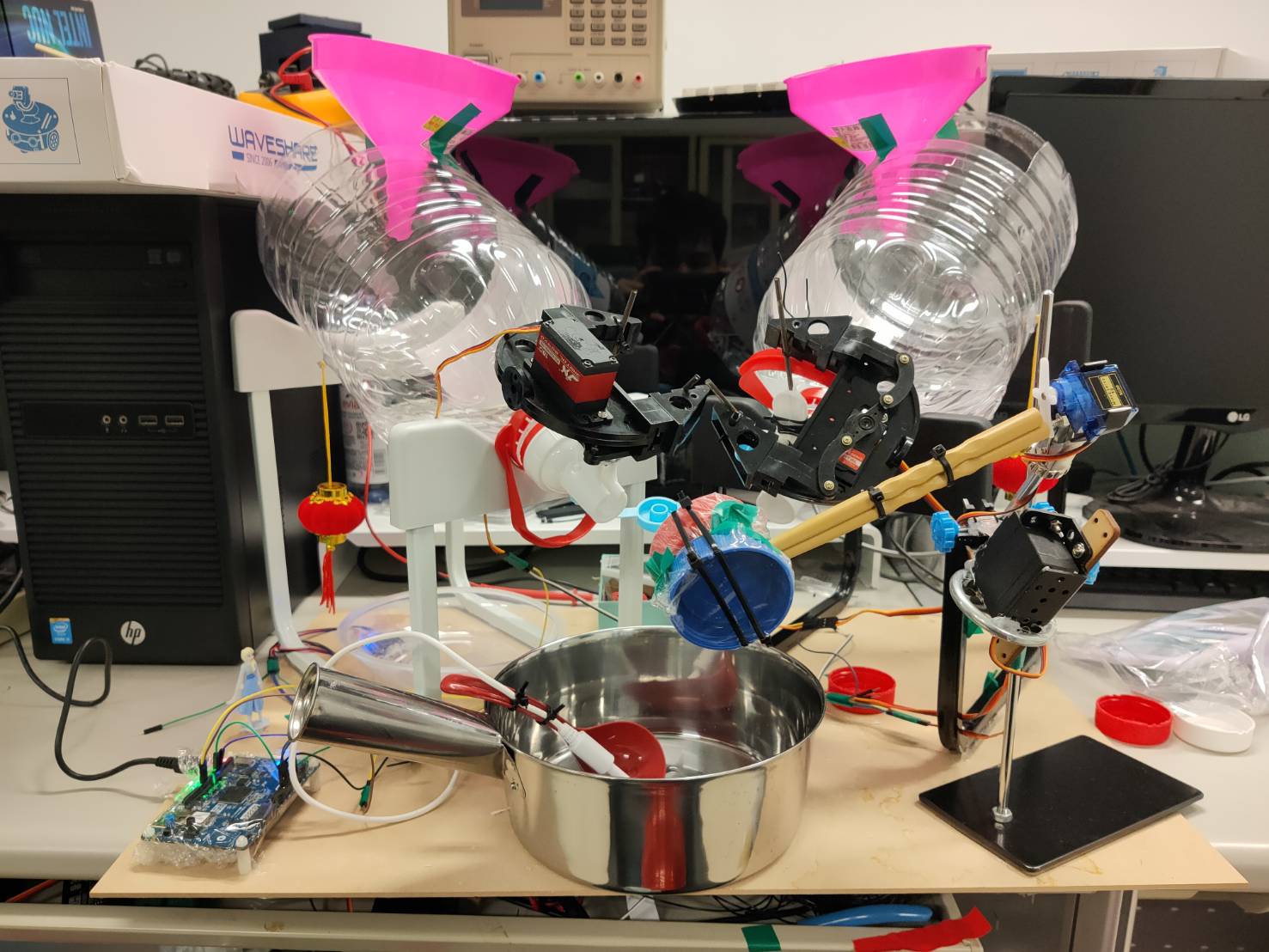
This course is designed for Junior and Senior of undergraduate students. It will acquaint students with the working principles of embedded systems with Mbed OS (RTOS), Linux operating systems, and embedded system programming with C/C++ Language. The outcomes of the course will let students know how to integrate embedded hardware, software, and middleware (such as OS libraries) to meet the functional requirements of embedded applications. The course will start with an introduction to embedded systems, processors, input/output systems, hardware/software tools, concepts of operating systems. Laboratories are provided to guide students to be familiar with programming and debugging tools for embedded systems. STM32L4 IoT node and Raspberry Pi 3/4 (also optional Nvidia Nano), will be used as development board.

The Biomedical Engineering Lab course is designed to introduce undergraduate students fundamentals of biomedical engineering. The lab course includes three introductory experiments and a term project. Through the three experiments, students can learn the basic principles of electrophysiology, design and realize electric circuits for ECG and EMG measurements, and wireless health data acquisition from wearable devices. The term project focuses on medical device innovation and team work. The students need to identify unmet clinical needs, invent possible solutions and implement them to bring innovative ideas to fruition. Through collaborations, the students will present their projects and demonstrate to the entire class.

